

Halo Infinite PC Graphics Benchmark
Today we're taking a expect at Halo Infinite's graphics performance by testing over thirty Nvidia and AMD GPUs at three resolutions. We'll likewise take a expect at quality preset scaling and VRAM requirements.
The Halo Infinite single player entrada was released just days ago on Dec 8, and with this 8th primary entry in the Halo series supersoldier Master Chief is back at it. For testing we're using a enervating section of the campaign, which we notice suitable for GPU stress testing and information technology's potentially far more consistent than using the multiplayer portion of the game.

Halo Infinite's multiplayer has been in open beta since November 15 and it's a free to play affair, which is extremely cool and nosotros wish more than games did this. Reviews accept besides been out for a little while. The game has been well received with 80% positive reviews on Steam from over 100,000 players who have given their 2-cents worth.
Personally, I've found the single histrion campaign enjoyable, it seems to run quite well on modest hardware and I've not run into any bugs or stability problems, and then that in itself is a big win these days. Information technology'due south also available on Steam, then you tin avoid the Windows Store if you desire, and so that'southward nice.

Every bit for the game engine, developer 343 Industries is using their own in-house "Slipspace Engine." This was purposely congenital for Halo Infinite, although its roots belong to a heavily updated version of the Blam! Engine. The updates take afforded the developer more creative and technical freedoms and that shows on the game's environments and mechanics. The custom designed engine also enables Halo Infinite to evolve as a platform, with new content, mechanics, and stories. Information technology also allows Infinite's non-linear and sprawling campaign to function with the addition of real-time exterior lighting created by an in-game day/night bike.
Of course, what we desire to know is how well optimized Halo Infinite is, and what kind of hardware yous will need to play the game at your desired frame rate.

Our benchmark pass has been done in the Outpost Tremonius mission, starting from when the boom door get-go opens. There's a heap of enemies here and loads of action. With the difficulty set to benchmark mode, a.k.a. easy, nosotros could run by all the enemies and rarely were they able to kill us and spoil the benchmark pass... we're just too quick.
The test data comprises benchmarks for 33 different GPUs at 3 resolutions every bit well equally a few extra tests mentioned earlier. Nosotros're using our Ryzen 9 5950X test system with 32GB of dual-rank, dual-channel DDR4-3200 CL14 retentivity. Display drivers used are AMD'southward Adrenalin 21.12.1 Optional and Nvidia's GeForce Game Ready Commuter 497.09.
Let's at present leap into the information...
Benchmarks
Starting with the 1080p resolution, we detect GeForce GPUs at the top of our graph, with the RTX 3090 beating the 6900 XT by a comfy 10% margin, while the RTX 3080 was too 10% faster than the 6800 XT, so this one goes in favor of the green team.
These loftier-end GPUs were all good for around 90 fps or meliorate at 1080p, then non amazing performance given the hardware existence used. That said, previous generation hardware still performed very well. The RTX 2080 Ti, for example, was good for 86 fps, placing information technology but ahead of the RX 6800 and 3060 Ti...
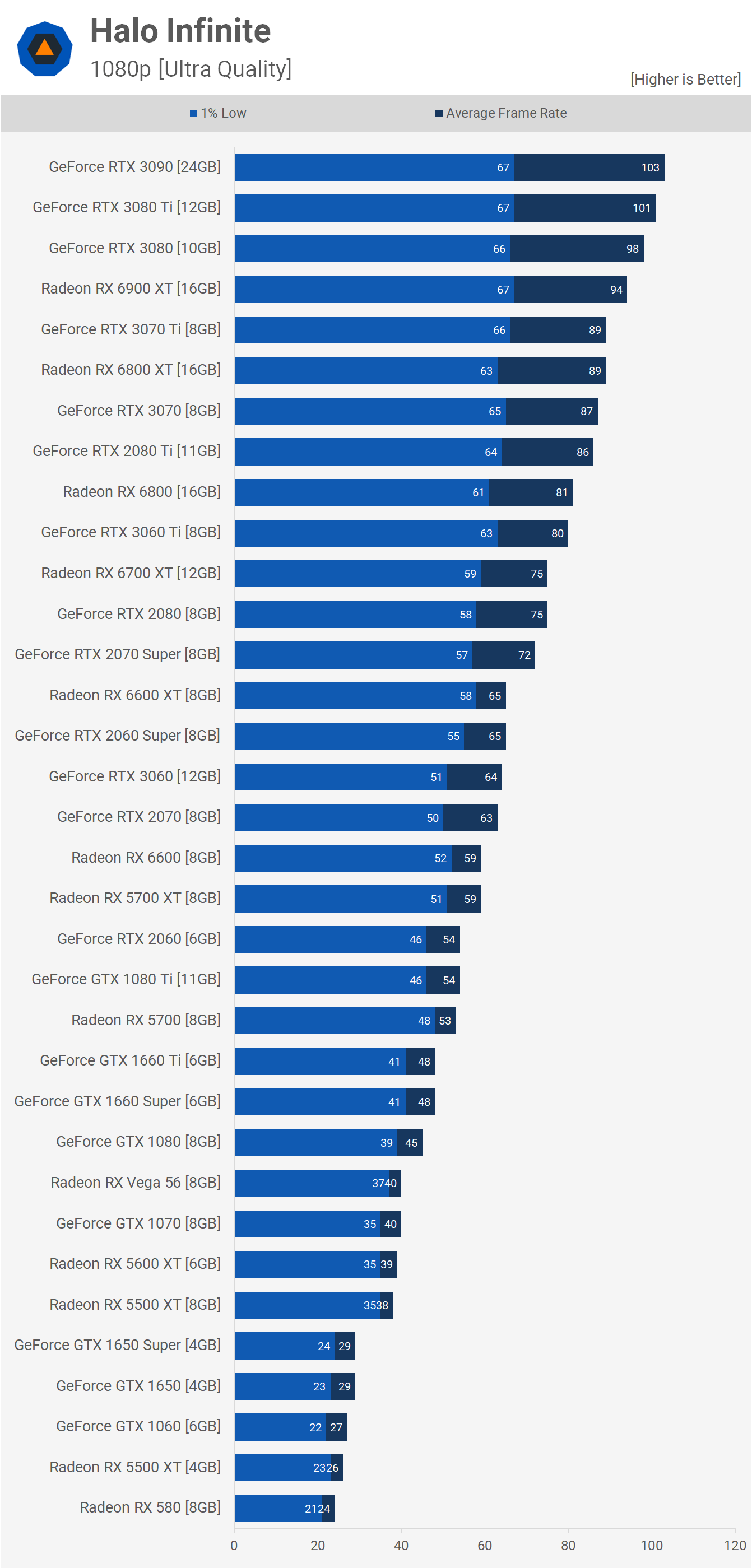
The RTX 2070 Super was too impressive with 72 fps on boilerplate and that meant it was 22% faster than the 5700 XT which is a huge win, especially given the 5700 XT has been institute matching and even beating the more expensive GPU in many recent games.
The new Radeon RX 6600 XT but matched the previous-gen RTX 2060 Super, which is a disappointing result, and the standard RX 6600 was slower than the standard RTX 2070. This is a weak result for the lower-end RDNA2 GPUs and first-gen RDNA.
Pascal GPUs as well had a weak showing with the GTX 1080 Ti only practiced for 54 fps on average and while it was yet very playable, that'southward only RTX 2060 levels of performance. Then we notice the RX 5700 with only 53 fps on average and across that we're down in the forty'southward.
Ideally, you won't want to go slower than a GTX 1080, equally Vega 56 and the GTX 1070 were skillful for but xl fps on average. The last playable cards include the 5600 XT and the 8GB version of the RX 5500 XT. Once again, we accept bear witness that 4GB graphics cards are no longer sufficient, at least not without heavily compromising on visuals.
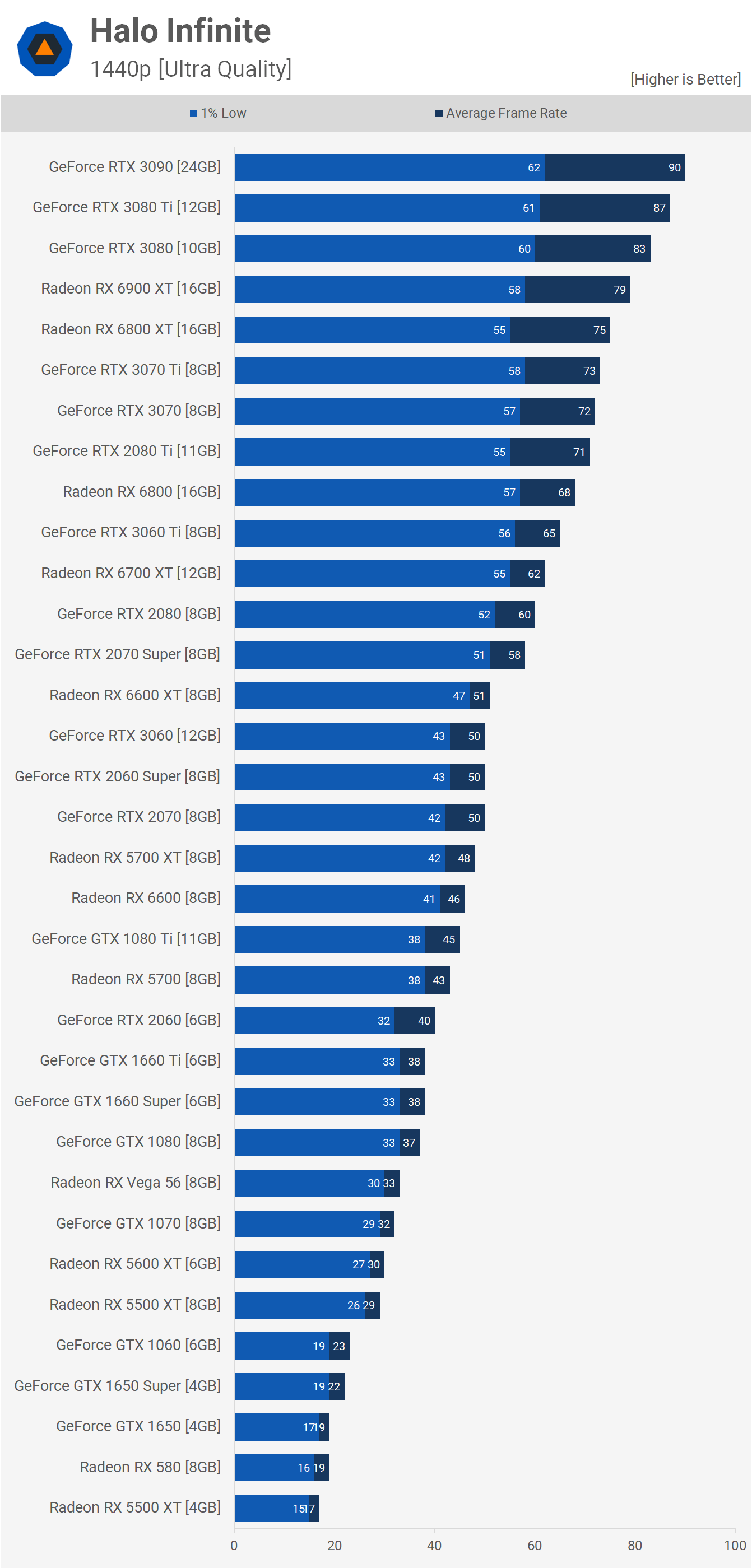
Bumping up the resolution to 1440p sees Nvidia Ampere GPUs pull further alee. At present the RTX 3090 sits at xc fps on average, which is 14% faster than the 6900 XT. The RTX 3080 is xi% faster than the 6800 XT also, which was good for 75 fps on average. These are all great results for the single player experience, and was simply a few frames faster than the vanilla RTX 3070.
The Turing-based GPUs practise well in Halo Infinite equally the RTX 2080 Ti matched the RTX 3070, and that's a best case upshot for the previous-gen role. Meanwhile, the RX 6800 was but a fraction faster than the 3060 Ti, which was a little faster than the 6700 XT.
The Radeon RX 6600 XT drops downward to 51 fps on average, which is about what we got out of the standard RTX 3060. This time the 5700 XT managed to match the RTX 2070 and 2060 Super -- a decent result, just not near as impressive as what we've seen in other recently released games.
The 5700 XT managed to edge out the standard RX 6600, as well equally the GTX 1080 Ti. And then we have the RX 5700 beating the RTX 2060 followed by the GTX 1660 Super, 1660 Ti and GTX 1080. Beyond that we're dropping down to thirty fps making parts like Vega 56, the GTX 1070, and slower GPUs unsuitable for these quality settings.
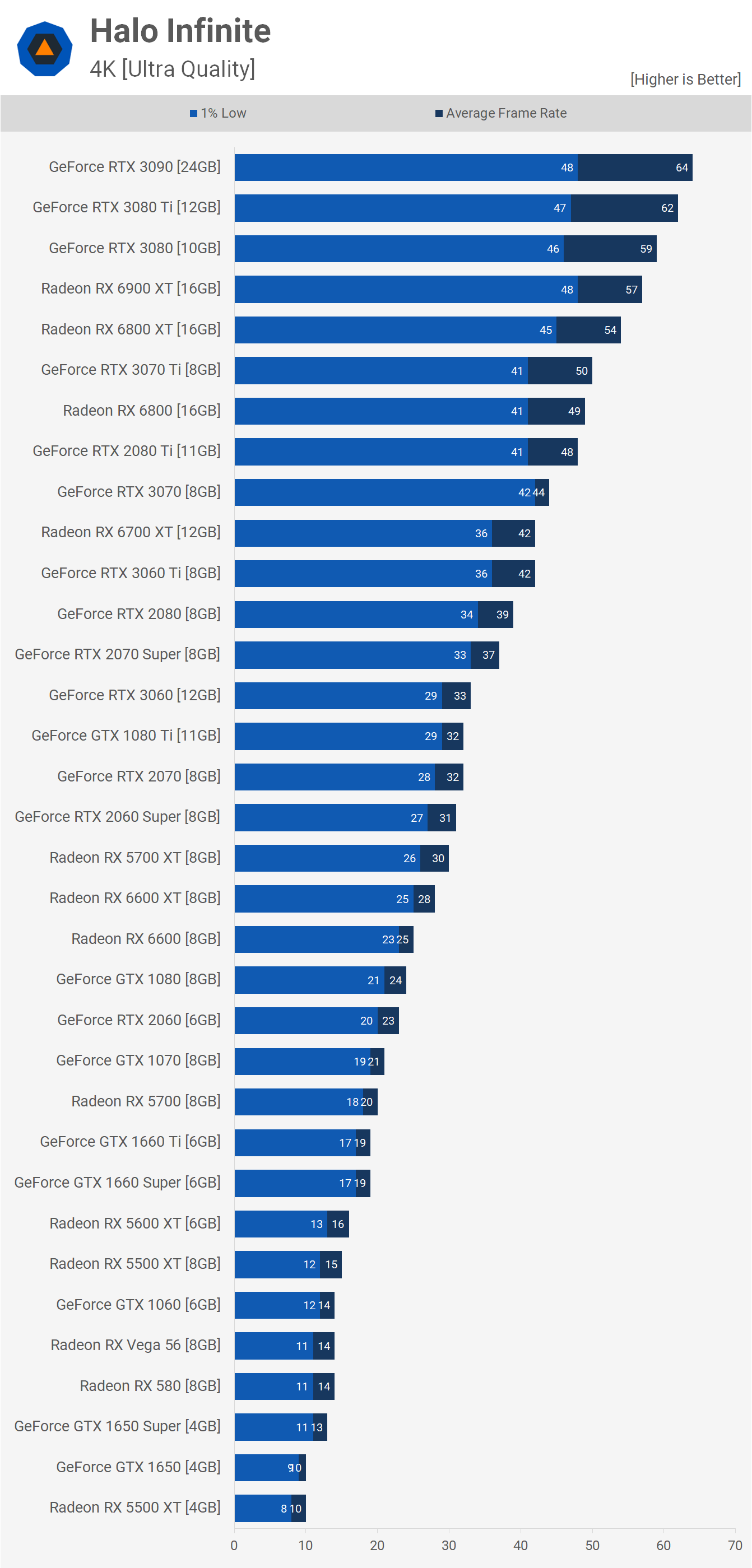
Finally we have our 4K benchmark and information technology's pretty straightforward as just a few GPUs manage to push over l fps on boilerplate. Nvidia dominates the pinnacle of our graph again with the GeForce RTX 3090, 3080 Ti and 3080 all beating the 6900 XT, while the 6800 XT was skillful for 54 fps on average. Then we see the RTX 3070 Ti dropping downwardly to 50 fps, closely followed by the RX 6800 and RTX 2080 Ti.
Anything less than that and nosotros run across the depression xl'south, and then anything slower than the Radeon RX 6700 XT or GeForce RTX 3060 Ti are unacceptable for polish 4K gameplay.
Preset Scaling
All the tests above were run using the Ultra quality preset, which is the highest bachelor. Simply how much extra performance can you lot squeeze out of these GPUs with lower quality settings?
In the instance of the Radeon RX 6900 XT, lowering the preset to High boosted frame rates past 11%, which is a minor improvement. And so from High to Medium we come across a farther 17% increase and from Medium to Depression a massive 44% boost for a 176 fps average.

Like scaling results were seen with the RTX 3090 which saw a xv% functioning uplift from Ultra to High, then 14% from High to Medium and finally 19% from Medium to Low. The low preset didn't offer the aforementioned kind of boost that we saw with RDNA2, simply this is to be expected with Ampere at 1080p.
With slower GPUs we constitute relatively similar results. AMD's old Vega 56 and the GeForce GTX 1080 saw a xv-eighteen% increment going from Ultra to High, then a 17-20% increment from High to Medium and then a 26 to 33% increase from Medium to Low.
Visual Quality Comparison
To put the preset scaling data into perspective, watch the video below for a quick expect at a visual comparison. Frankly, there isn't a huge difference between these presets, especially when comparing Medium, High and Ultra. Low stands out more, with poorer lighting and shadow quality. But overall it'south quite surprising but how little difference there is between the diverse presets and while we know Ultra typically offers very little over Loftier, and the performance difference in Halo Infinite wasn't huge, the difference between Medium and Ultra is minimal...
Some of the more noticeable differences include shadow details and crisper looking textures, especially afar textures, but over again these are subtle. In our opinion, the difference for indoor environments with shorter draw distances are even less obvious and nosotros could easily find ourselves playing using the Medium preset if needed.
VRAM Usage
Here's a look at VRAM usage corresponding to the section of the game we tested (third mission called Outpost Tremonius). Please practise note that testing VRAM usage is not verbal as different sections of the game will require more or less memory, so there's a adventure that the demand volition be even higher in other parts of the game.
For 1080p, you want a minimum of 6GB when using the Ultra quality preset, and we certainly saw evidence of this with 4GB graphics cards suffering a lot at this resolution.

Then at 1440p you lot'll ideally want a minimum of 8GB, though GPUs like the RTX 2060 played fine. For those of you gaming at 4K, VRAM is less of a concern in the sense that nigh GPUs capable of delivering satisfactory results hither have more than 8GB.
What We Learned & Boosting Performance
First, let's talk about quality presets. Unremarkably we effort to exam at least 2 presets across all 30+ GPUs, simply instead nosotros took a shortcut, settled on Ultra plus some reasonably detailed preset scaling results and a bones epitome quality comparing. What we found was that most gamers wanting to squeeze more functioning out of their GPUs in Halo Infinite should give the Medium preset a attempt, and this will boost performance past at to the lowest degree 30%.
... well-nigh gamers wanting to squeeze more performance out of their GPUs in Halo Infinite should give the Medium preset a try, and this will boost functioning past at to the lowest degree xxx%.
Both the RTX 3090 and 6900 XT were xxx% faster using Medium opposed to Ultra, while the GTX 1080 and Vega 56 were both 38% faster. For the older GPUs, that was the difference between ~xl fps at 1080p to something closer to 55 fps, and that'southward a huge touch on how smoothly the game plays.

Some other noteworthy mention is "Async Compute," which tin be found towards the lesser of the "Video" card. For some reason this option is disabled by default. All mod GPUs now back up Async Compute and we institute that enabling that will boost frame rates by 5-10%, depending on the quality settings and GPU.
For those of you happy to use the Medium preset at 1080p and are seeking a sixty fps experience, this should be possible with a GTX 1080, 1660 Ti, 1660 Super or Radeon RX 5700. For the aforementioned performance using Ultra you'll require a 5700 XT, RX 6600, RTX 2070 or RTX 3060, so the hardware requirements on PC are quite steep. Unfortunately, for those of you still clinging to older hardware such as the Radeon RX 580 or GeForce GTX 1060, you'll need to use the lowest quality settings for over xl fps at 1080p.

Also of note, we are non alone in testing Halo Space and other well respected outlets similar Estimator Base, KitGuru and GameGPU have ran like tests with varied results. There is a follow-upwardly video on Hardware Unboxed that explains where the differences lie and more importantly why some of those publications are reporting higher frame-rate averages with Radeon GPUs. In a nutshell, two of those sites used a benchmark run that is not equally demanding, while the 3rd 1 used the same mission that we used for testing, and in that case the results are a close match to ours. Neither result is right or wrong, simply simply we have tested different parts of the game and as long every bit all GPUs were tested under the same weather, the results are all valid.
Finally, information technology appears as though Halo is very CPU intensive. We played the entrada for an hr on a Ryzen 5 3600 and while performance was generally skilful, nosotros observed the CPU was constantly maxed out, often hitting 100% load with a loftier-end GPU. RAM usage frequently hovered around 10 GB in total when playing the game, so this championship should exist perfectly playable with 16GB, but 32GB is always a nice luxury.
Shopping Shortcuts:
- GeForce RTX 3070 Ti on Amazon
- GeForce RTX 3080 on Amazon
- Radeon RX 6800 on Amazon
- Radeon RX 6600 XT on Amazon
- GeForce RTX 3060 on Amazon
- Intel Core i5-12600K on Amazon
- Intel Core i7-12700K on Amazon
- AMD Ryzen 7 5800X on Amazon
- AMD Ryzen ix 5900X on Amazon

Source: https://www.techspot.com/article/2382-halo-infinite-benchmark/
Posted by: lopezbince1954.blogspot.com
0 Response to "Halo Infinite PC Graphics Benchmark"
Post a Comment